Product Designer
Usual.
Eliminating drive-through lines for busy commuters with a voice-first ordering app.
- Scope
- End-to-end Product Design
- Team
- Solo
- Duration
- 4 months
- Platform
- iOS
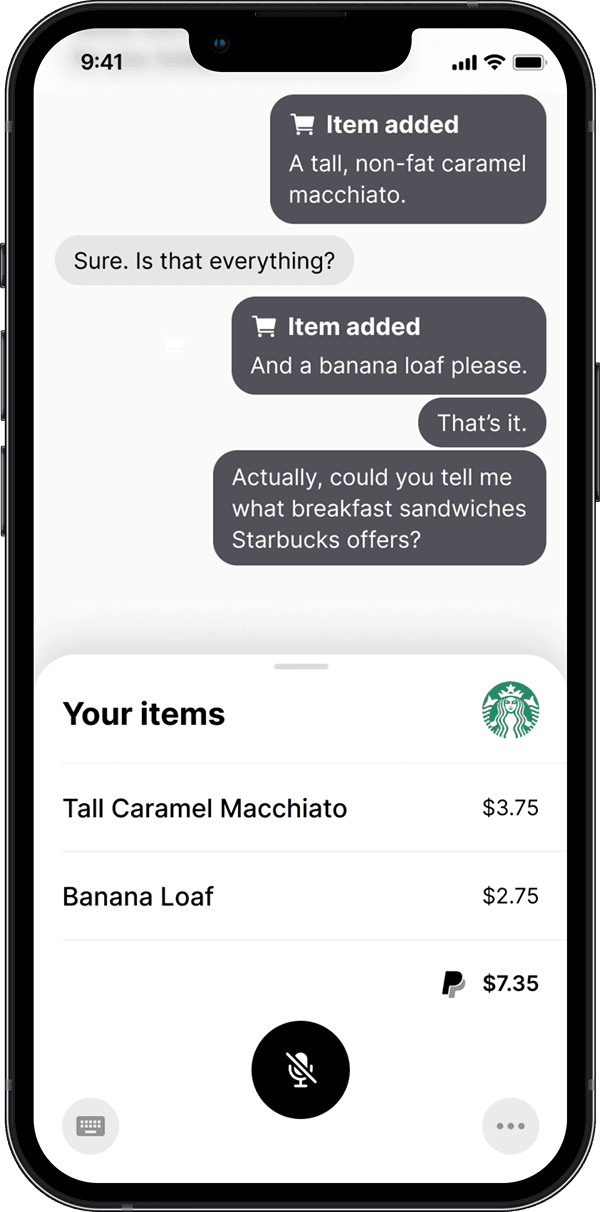
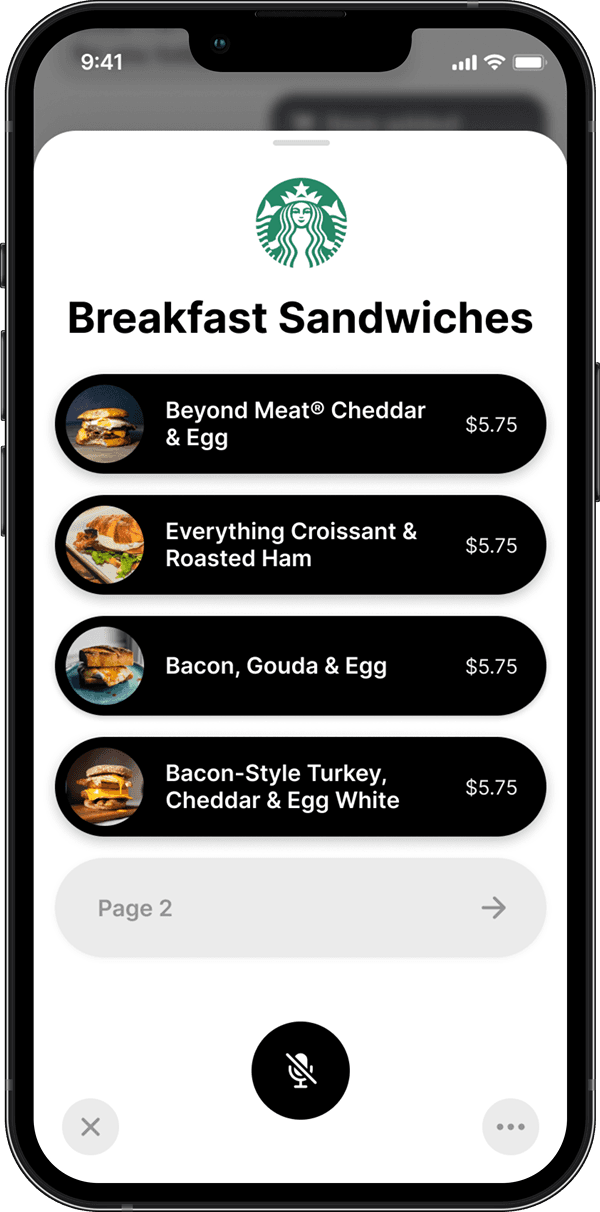
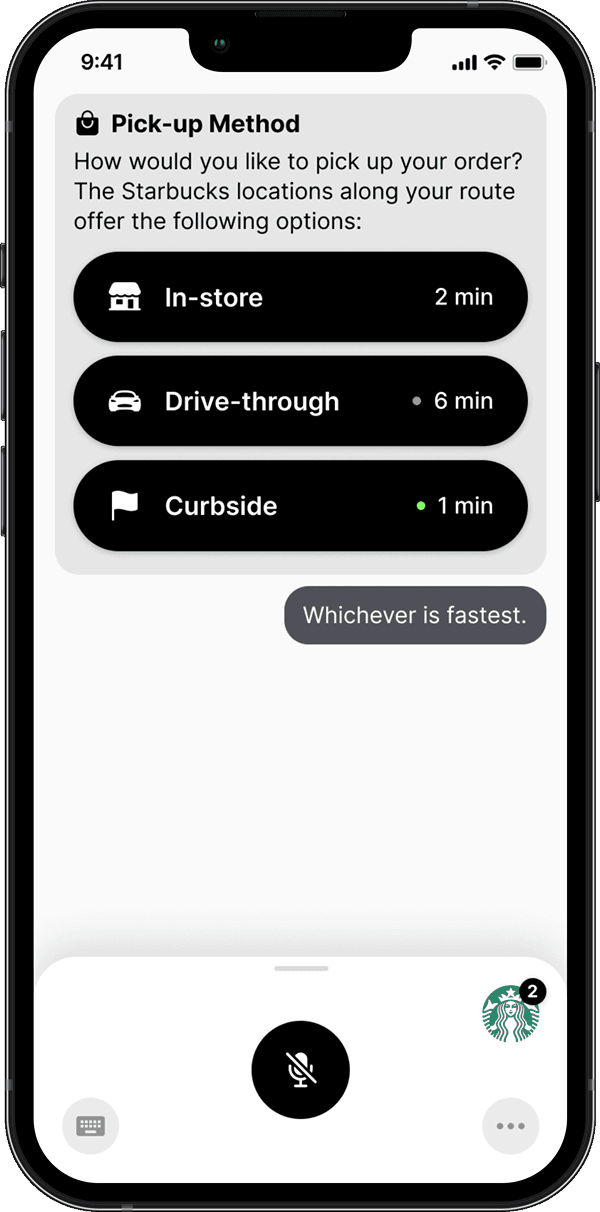
Customers lose 4+ minutes per drive-through visit.
Drive-through wait times and fulfillment errors increase yearly, decreasing customer satisfaction and creating unnecessary pollution through idling. Usual addresses drive-through overcrowding to implement a lasting solution that eliminates drive-through idling.
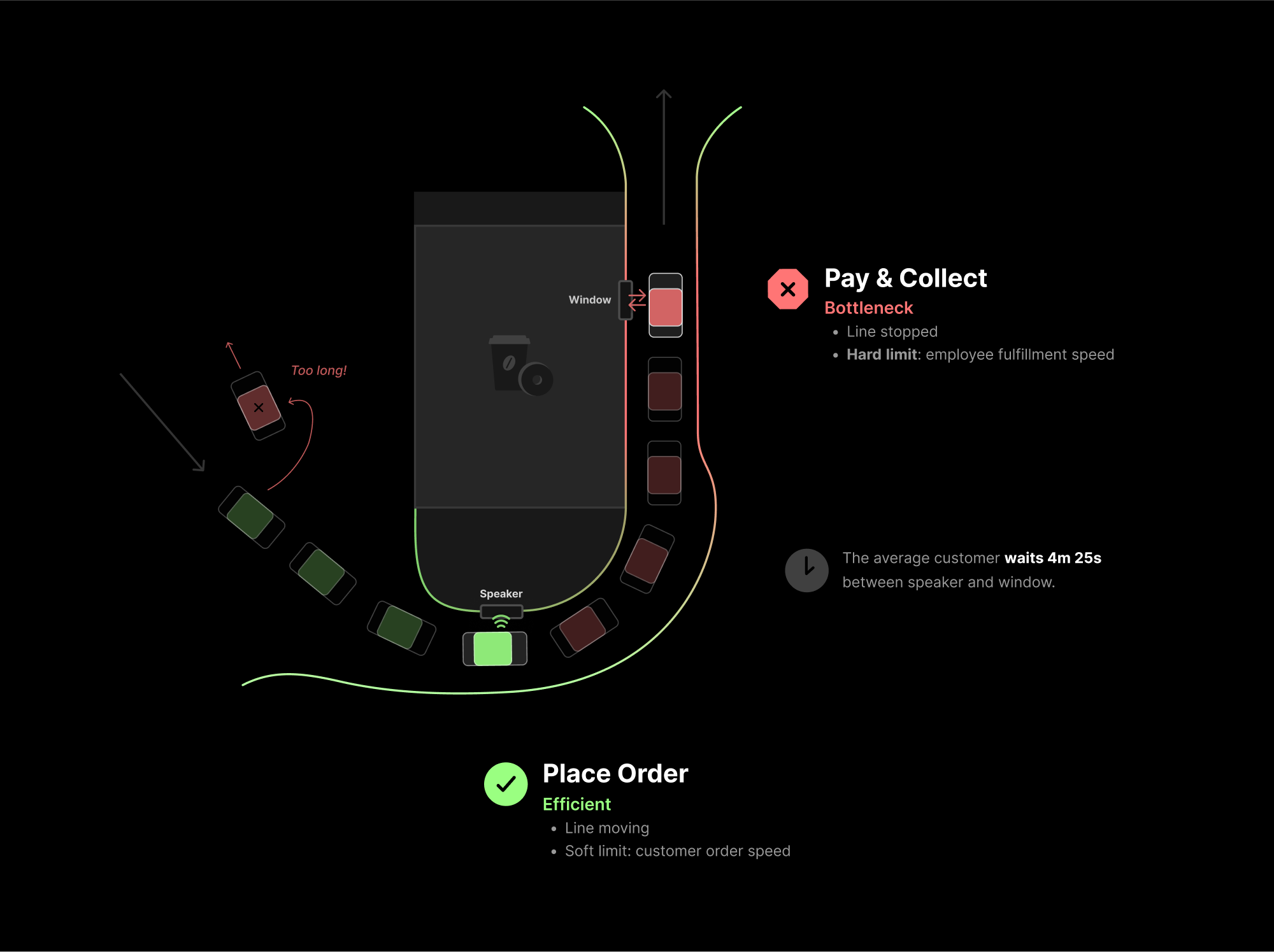
For drive-through customers, this is just a stop along the way.
Through observation and contextual inquiry, I identified three core user goals: staying comfortable, obtaining desired items, and reliably reaching destinations on time (e.g. arriving at work punctually). While walk-in customers immediately see products and estimate waits based on visible lines and staff activity, drive-through customers face uncertainty. Paired with fast-service expectations, this contributes to mounting frustration.
On the business side, quick-service restaurants operate on thin margins and rely on sales volume — 82% of which comes through the drive-through, on 6–9% profit margins. While 42% are investing in loyalty programs, 35% of customers explicitly state that “tangible improvements to ordering and pickup” would have the greatest impact on their loyalty. The rise of loyalty programs suggests restaurants may be avoiding the core issue rather than addressing it.
Employees can’t fulfill orders faster than customers can place them.
The bottleneck lies in order placement being quick while fulfillment takes considerably longer than drive-up time. Extended waits are amplified by order complexity, customer volume, and fulfillment errors that require correction.
How might we help commuters place orders while driving?
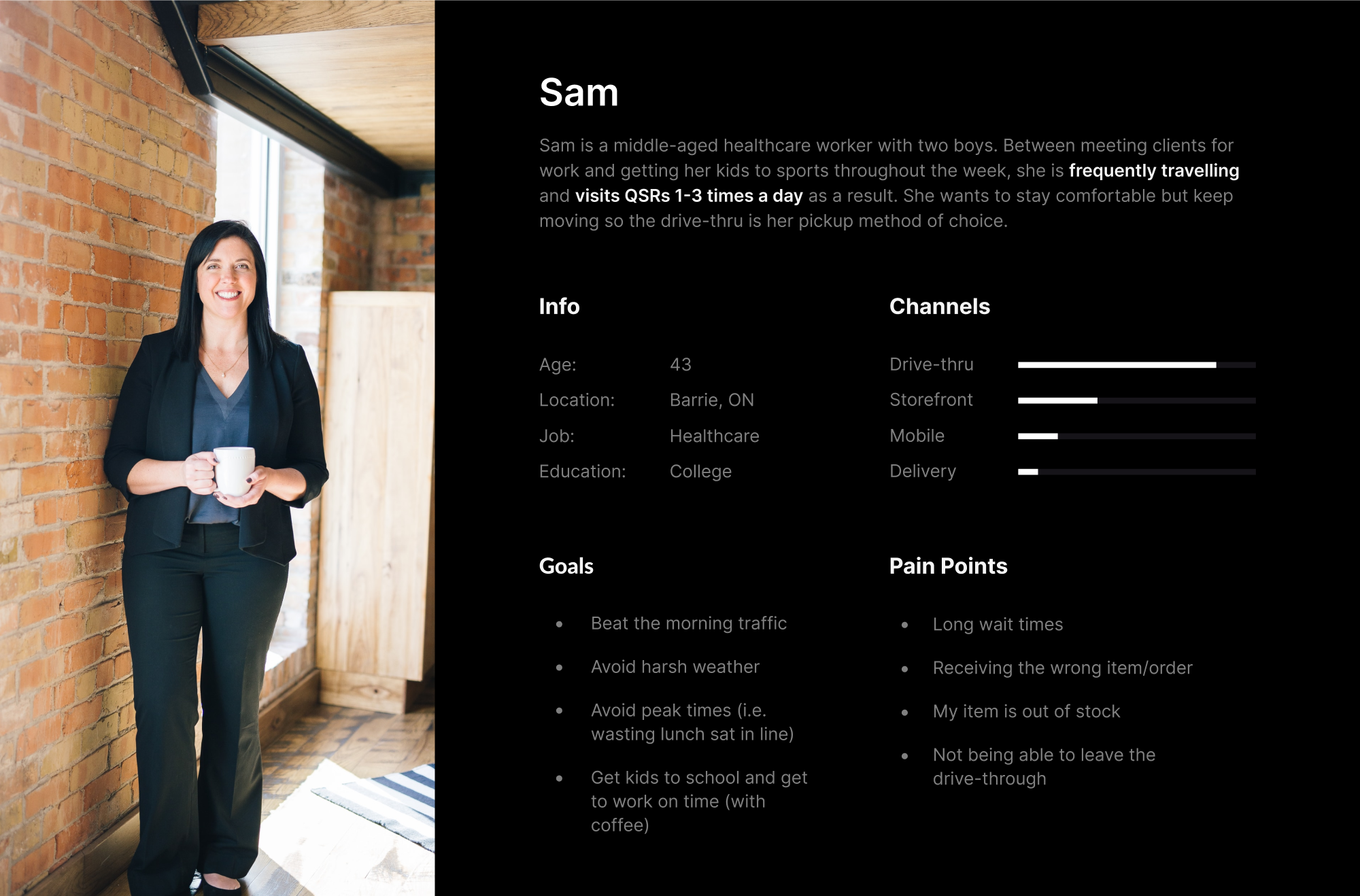
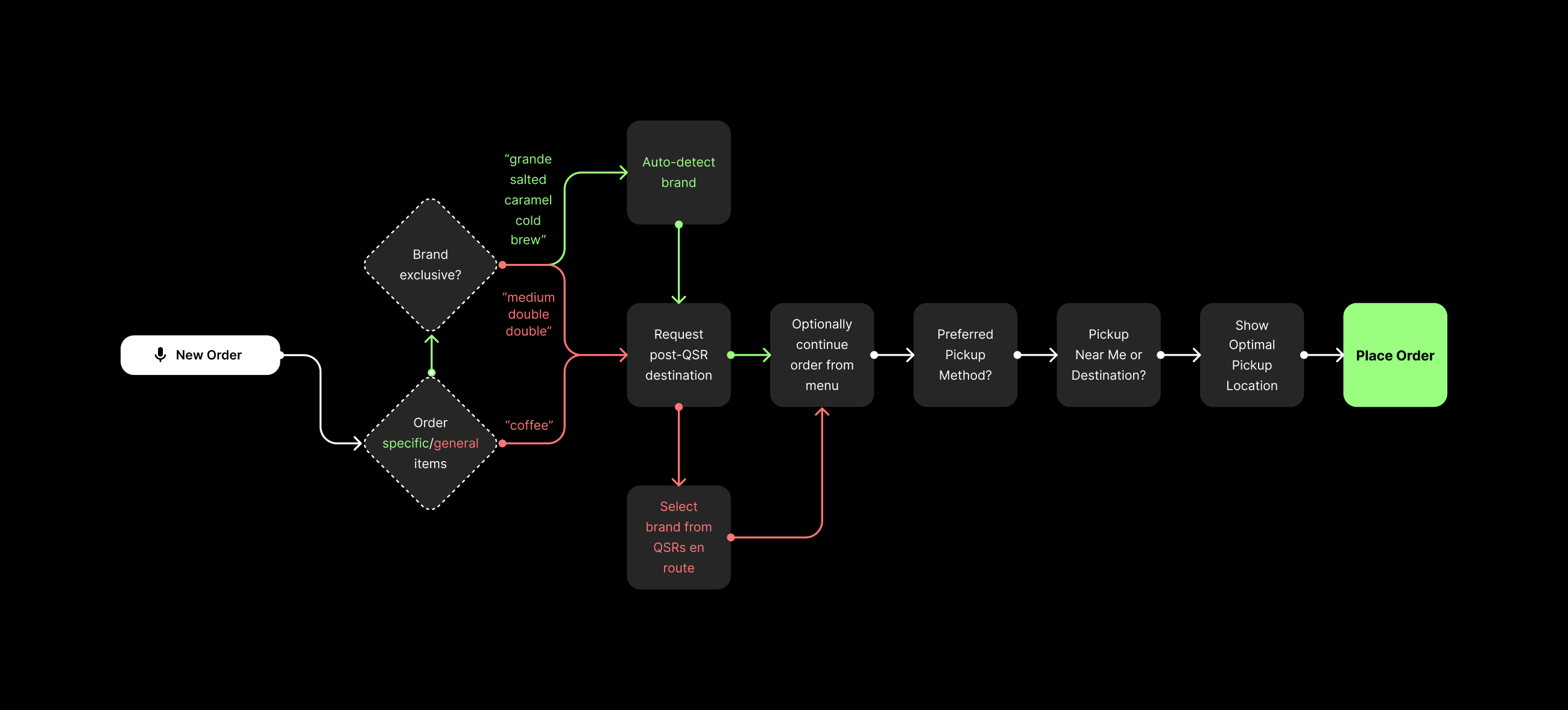
Pre-ordering would give employees preparation time and reduce on-site ordering. While mobile apps seemed logical, existing solutions prioritized delivery and lacked ease-of-use for on-the-go drivers unable to spend time typing through menus. For the persona “Sam,” a busy morning coffee routine offered limited app interaction windows — only after school drop-off, while driving. The only reasonable solution was a voice app enabling hands-free ordering.
Because Sam drives with limited attention and memory, the app should skip or automate much of the order process. Three requirements followed from her goals:
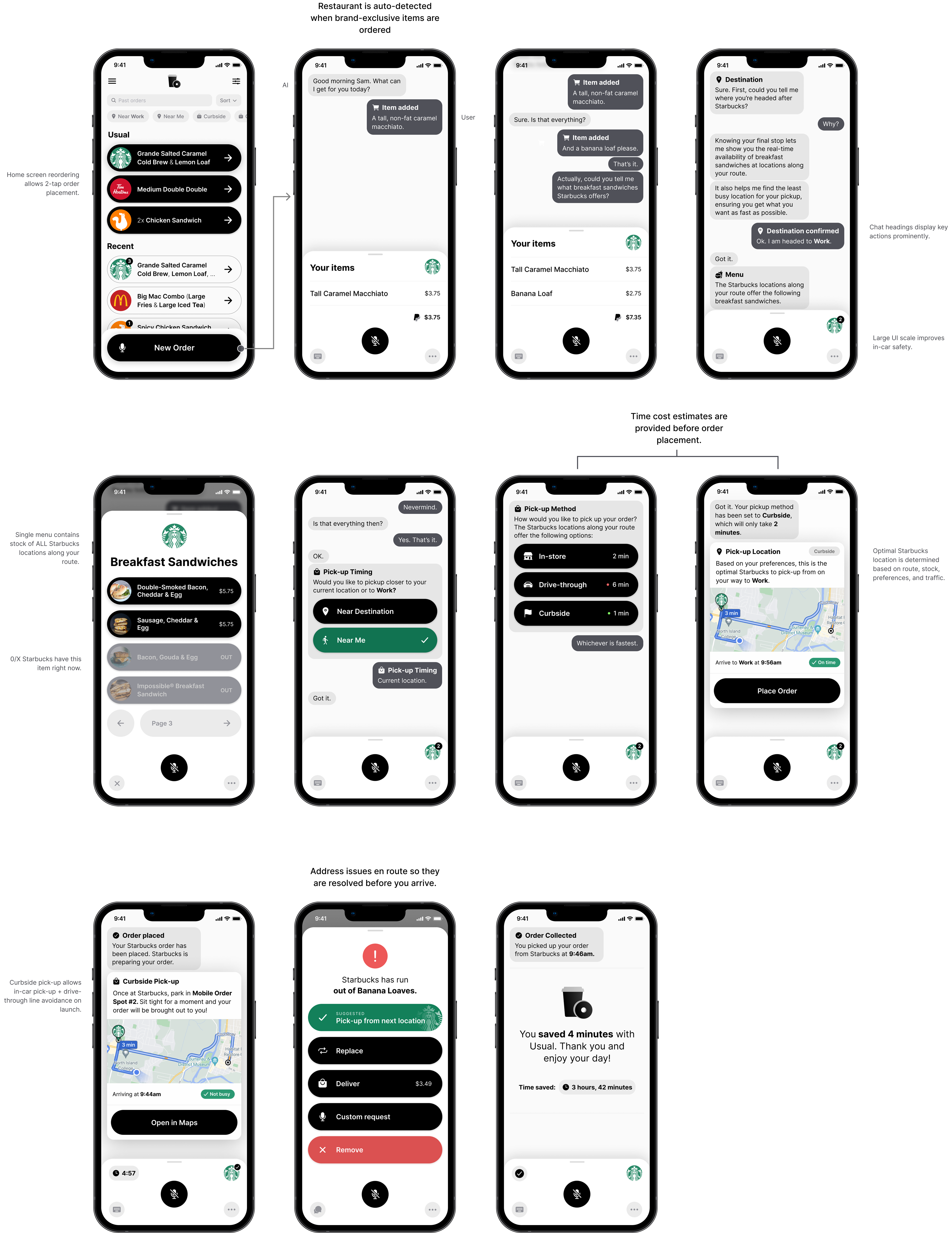
- Provide information before ordering — Sam decides whether to order based on expected time cost and item availability.
- Integrate with the overall trip — Sam doesn’t care which location she orders from, only that it aligns fastest with her route.
- Resolve order issues before arrival — an issue requiring a remake means returning to the 4-minute wait.
Skip the line. Arrive on time.
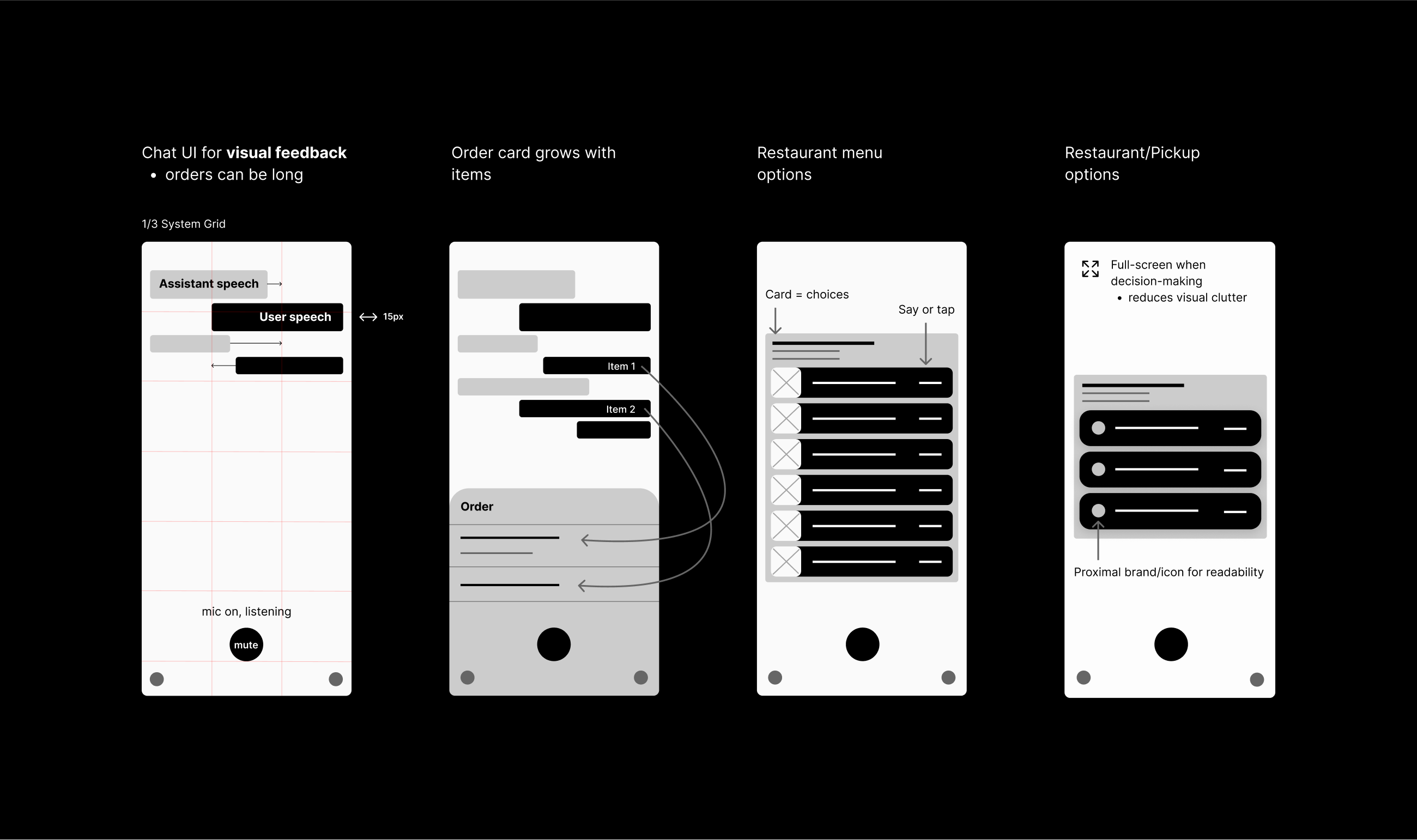
Early iterations focused on a minimalist UI with high-contrast black and white. The key issues were sizing and readability — a chat UI tracking system progress isn’t useful if it can’t be read at arm’s length. The result is high contrast, non-distracting, and scannable.
Usual leverages voice interaction so busy commuters can pre-order while driving, increasing employee fulfillment time and, over time, eliminating line-ups altogether.
Hypothetical results across user, business, and environment.
User — Adoption wouldn’t be immediate; many customers would continue ordering in person. But the product represents a significant enough improvement that the channel would eventually surpass drive-through usage, ultimately giving the 4 minutes per visit back to the user.
Business — Sales losses stem from slow service and fulfillment errors — unavoidable when employees rush to fulfill 5-minute orders in 30 seconds. Adequate fulfillment time enables seamless, error-free pickup, yielding substantial increases in sales volume, retention, and satisfaction.
Environment — The U.S. Department of Energy estimates personal vehicles generate roughly 30 million tons of CO₂ annually from idling alone. Eliminating even 1 million tons would equal removing 216,000 vehicles from the roads each year.
Less research, more design — and knowing when to break the rules.
Less research, more design. Leaning on my psychology background led to excessive interviews, surveys, and market research that overcomplicated things. The first user interviews provided 80% of the design requirements in 20% of the time — the remaining hours would have served iteration and testing better.
Know when to break the rules. The project required classical UX deliverables, but not all applied. Wireframing was awkward when the design is one main screen with minimal touch interaction. Standardized processes guide helpfully, yet rigid adherence fails for non-standard products.
Efficient interface design. I was initially unfamiliar with auto-layout, column grids, and 8-pixel nudges, and wasted time designing without them. They’ve since substantially sped up my UI workflow.